
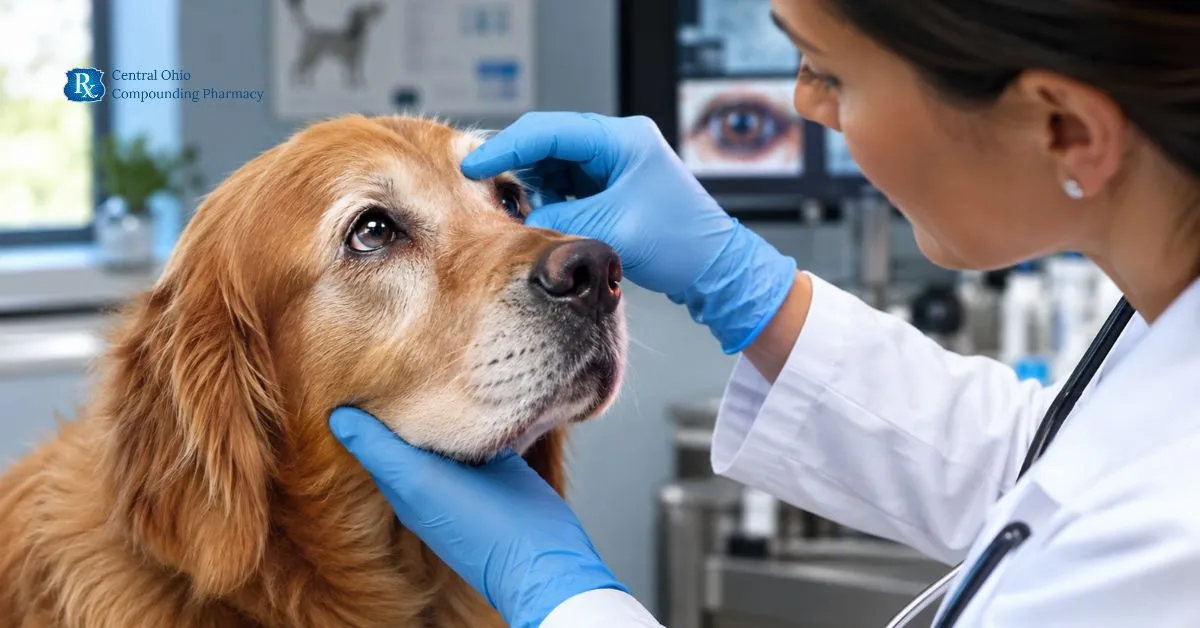
Key Takeaways: Understanding Dry Eye (KCS) in Dogs
- What is KCS? Keratoconjunctivitis sicca (KCS), commonly called dry eye, occurs when a dog’s eyes do not produce enough tears to properly lubricate and protect the ocular surface.
- Common Symptoms: Dogs with KCS may experience thick eye discharge, redness, squinting, irritation, and changes in corneal appearance.
- Diagnosis: Veterinarians commonly use the Schirmer tear test to measure tear production and assess the condition.
- Therapy Considerations: Cyclosporine is frequently prescribed for immune-mediated KCS. Tacrolimus may be considered when the response to previous medications is insufficient.
- Veterinary Compounding: Compounded tacrolimus ophthalmic preparations may provide formulation options when commercially available medications do not meet an individual dog’s medical needs.
Central Ohio Compounding Pharmacy, located in Worthington, Ohio, works with veterinary prescribers on specialized ophthalmic medication preparations, including compounded tacrolimus.
Tacrolimus for Dry Eye in Dogs: Understanding KCS
Dry eye is a common condition in dogs that may cause persistent irritation, unusual eye discharge, and changes to the eye’s surface. Known medically as keratoconjunctivitis sicca (KCS), this condition occurs when tear production is insufficient to maintain normal ocular surface health.
Veterinarians use several approaches to manage canine KCS, including prescription medications such as cyclosporine and, in selected cases, tacrolimus.
For dogs with immune-mediated KCS, tacrolimus eye drops may be considered when previous medications haven’t produced the desired response.
At Central Ohio Compounding Pharmacy (COCP), we work with Ohio veterinary prescribers on specialized ophthalmic medication requests, including compounded tacrolimus preparations.
What Is Keratoconjunctivitis Sicca (KCS) in Dogs?
Keratoconjunctivitis sicca (KCS), commonly called dry eye, is a condition involving inadequate tear production or abnormalities of the tear film.
A healthy tear film helps lubricate the cornea, remove debris, and maintain the normal function of the eye.
When tear production decreases, the cornea and conjunctiva may become irritated and inflamed. Chronic cases may also involve corneal pigmentation, scarring, or ulceration.
Research indicates that many cases of canine KCS are associated with immune-mediated inflammation affecting the lacrimal glands, which produce the watery portion of tears.
What Causes Dry Eye in Dogs?
Several factors may contribute to canine KCS.
Immune-Mediated Conditions
Immune-mediated inflammation is a common cause of reduced tear production in dogs. The inflammatory process may interfere with the normal function of the tear-producing glands.
Breed Predisposition
Certain breeds, including Cocker Spaniels, Shih Tzus, Bulldogs, and West Highland White Terriers, are more frequently associated with KCS.
However, dry eye may occur in dogs of any breed.
Medications and Other Medical Conditions
Certain medications, neurologic disorders, and abnormalities affecting the lacrimal glands may also contribute to dry eye.
Because KCS has multiple possible causes, identifying the underlying condition is important when establishing a veterinary therapy plan.
What Are the Symptoms of Dry Eye in Dogs?
Common symptoms of canine KCS include:
- Thick, sticky, or mucus-like eye discharge
- Redness of the conjunctiva
- Frequent blinking or squinting
- Rubbing or pawing at the eyes
- A dull or dry appearance to the cornea
- Corneal cloudiness or pigmentation
- Persistent eye irritation
Symptoms vary depending on the condition’s severity and duration.
Some of these signs also occur with other eye disorders, including corneal ulcers and infections. A veterinarian should evaluate any persistent or worsening eye symptoms.
How Do Veterinarians Diagnose KCS?
Veterinarians diagnose KCS through an ophthalmic examination and testing of tear production.
One commonly used diagnostic tool is the Schirmer tear test.
What Is the Schirmer Tear Test?
The Schirmer tear test measures the amount of tear fluid produced over a specified period, typically one minute.
A small strip of specialized paper is placed near the lower eyelid, and the veterinarian measures the amount of moisture collected.
The results help assess tear production and may also be used during follow-up examinations.
Other diagnostic procedures may include fluorescein staining, evaluation of the corneal surface, and additional tear film assessments.
Iwashita et al. (2023) reviewed diagnostic approaches for canine tear film deficiencies and emphasized that evaluating both tear quantity and tear quality may provide important clinical information.
What Is Tacrolimus, and Why Is It Used in Canine Ophthalmology?
Tacrolimus is an immunomodulating medication belonging to a class of drugs known as calcineurin inhibitors.
These medications affect immune signaling pathways, including those associated with T-cell activation.
In veterinary ophthalmology, researchers have studied topical tacrolimus in dogs with immune-mediated KCS.
Berdoulay et al. (2005) studied 0.02% tacrolimus ophthalmic suspension in dogs with KCS. The researchers reported increased tear production, including in some dogs that had previously responded poorly to cyclosporine.
Results can vary between dogs, and findings from one study may not apply to every compounded formulation.
When Might a Veterinarian Consider Tacrolimus Instead of Cyclosporine?
Cyclosporine is commonly prescribed for dogs with immune-mediated dry eye. A comparative clinical study by Hendrix et al. (2011) found that both cyclosporine and tacrolimus increased tear production in dogs with KCS, with no statistically significant difference in Schirmer tear test results between the groups.
In some cases, veterinarians may reassess the therapy plan when a dog experiences an insufficient response to cyclosporine.
That evaluation may include:
- Reviewing Schirmer tear test results
- Assessing the ocular surface
- Reviewing previous medication use
- Evaluating medication tolerability
- Considering the underlying cause of dry eye
Tacrolimus may be among the alternatives a veterinarian evaluates.
The decision should be based on the individual patient’s condition, rather than assuming that one medication is universally preferable.
What Is the Role of Veterinary Compounding in KCS?
Some dogs require a prescribed medication formulation that is not available as a suitable commercial product.
Veterinary compounding involves preparing medications for individual animal patients based on a veterinarian’s prescription.
For ophthalmic preparations, the pharmacist may evaluate:
- The prescribed medication concentration
- The requested dosage form
- Ingredient compatibility
- Vehicle suitability
- Stability and storage requirements
- Packaging appropriate for ophthalmic use
Potential benefits of compounding include flexibility in preparing specific strengths or formulations when a veterinarian identifies an individual medical need.
Compounded medications should not be assumed to produce better clinical results than commercially available products.
How Should Dogs With KCS Be Monitored?
Dogs diagnosed with KCS often require ongoing veterinary evaluation.
Follow-up examinations may include repeat Schirmer tear tests, assessment of ocular inflammation, and examination of the cornea.
Pet owners should contact their veterinarian if their dog develops new or worsening redness, discharge, squinting, cloudiness, or apparent eye pain.
Prescription ophthalmic medications should be used only according to the veterinarian’s instructions.
Veterinary Ophthalmic Compounding in Central Ohio
Central Ohio Compounding Pharmacy, located in Worthington, Ohio, collaborates with veterinarians on specialized compounded medication requests, including ophthalmic preparations for canine patients.
Our pharmacists review prescription formulation requirements and work with veterinary professionals to discuss medication strengths, dosage forms, ingredient compatibility, and preparation considerations.
Pet owners who are concerned about dry eye should first consult their veterinarian for diagnosis and therapy recommendations.
Veterinary professionals with questions about compounded tacrolimus or other ophthalmic preparations can contact Central Ohio Compounding Pharmacy to discuss formulation options and prescription requirements.
References
Berdoulay, A., English, R. V., & Nadelstein, B. (2005). Effect of topical 0.02% tacrolimus aqueous suspension on tear production in dogs with keratoconjunctivitis sicca. Veterinary Ophthalmology, 8(4), 225–232. Read article
Hendrix, D. V. H., Adkins, E. A., Ward, D. A., Stuffle, J., & Skorobohach, B. (2011). An investigation comparing the efficacy of topical ocular application of tacrolimus and cyclosporine in dogs. Veterinary Medicine International, 2011, Article 487592. Read article
Iwashita, H., Sebbag, L., Leonard, B. C., & Saito, A. (2023). A review of diagnostic tests for qualitative and quantitative tear film deficiency in dogs. Veterinary Ophthalmology, 26(S1), 5–15. Read article
Williams, D. L. (2008). Immunopathogenesis of keratoconjunctivitis sicca in the dog. Veterinary Clinics of North America: Small Animal Practice, 38(2), 251–268. Read article
Disclaimer: Compounded medications are not FDA-approved. This article is for educational purposes and does not replace professional veterinary advice.